

Understanding a Government Shutdown and Its Effects
Headlines about a potential government shutdown can create uncertainty. While the term sounds serious, its direct impact on most people is often less dramatic than it seems. Understanding what happens during a government shutdown can help you separate the facts from the noise and see how it might affect you.
This post will explain the mechanics of a shutdown, identify which services continue and which are paused, and explore the potential effects on your personal finances and the broader economy. We'll cover everything from Social Security payments to air travel, providing a clear guide to navigating this unique situation.
What is a Government Shutdown?
A government shutdown occurs when Congress fails to pass funding legislation to finance government operations. Without an approved budget or a temporary extension, federal agencies must stop all non-essential functions until new funding is authorized. This process leads to the temporary furlough of many federal workers.
However, not all government activity ceases. Services deemed "essential" for public safety and national security continue to operate. This distinction between essential and non-essential functions is key to understanding how a shutdown affects daily life.
Excepted Employees vs. Furloughed Workers
During a shutdown, federal employees fall into two main categories:
- Excepted Employees: These are workers whose jobs are considered essential. This group includes air traffic controllers, law enforcement officers, active-duty military personnel, and many healthcare professionals in federal facilities. Excepted employees continue working but often do so without receiving a paycheck until the shutdown ends. They typically receive back pay once a funding agreement is reached.
- Non-Excepted (Furloughed) Employees: These are federal workers whose jobs are deemed non-essential during the shutdown period. A federal workers furlough means these employees are sent home and are not permitted to work. This can affect services at national parks, passport agencies, and certain administrative offices. Like excepted employees, furloughed workers are usually granted back pay after the shutdown concludes.
How a Government Shutdown Affects You
For many, the most pressing question is about the direct impact on their daily lives and finances. While the effects can vary, several key areas remain largely stable.
Will Social Security Payments Continue?
Yes, Social Security during a shutdown continues as scheduled. Social Security is funded through a trust fund that is separate from the annual congressional budget process. Therefore, retirees and other beneficiaries will continue to receive their checks without interruption. The same applies to Medicare and Medicaid benefits, which are also considered mandatory spending and are not affected by a lapse in discretionary funding.
Is Air Travel During a Shutdown Safe?
Air travel remains safe and operational. Air traffic controllers are excepted employees, meaning they continue to guide flights and manage the nation's airspace. Likewise, Transportation Security Administration (TSA) agents and Customs and Border Protection (CBP) officers at airports also continue their duties to ensure passenger safety and security.
Travelers might, however, experience some inconveniences. For example, processing new passport applications could be delayed, and national parks or Smithsonian museums, which are popular tourist destinations, will likely be closed.
Financial Markets and the Economic Impact of a Shutdown
Investors often wonder about the relationship between financial markets and a shutdown. Historically, the market's reaction to government shutdowns has been relatively muted. Because these events are often anticipated, markets tend to price in the possibility ahead of time. Past shutdowns have typically had a minimal and short-lived impact on broader economic growth, although specific sectors or companies with significant government contracts may feel a more direct effect.
The primary economic impact of a shutdown comes from the reduced spending of furloughed federal workers and the disruption to government services and contracts. While the impact is often small relative to the overall U.S. economy, a prolonged shutdown can create greater economic headwinds.
Managing Your Personal Finance During a Shutdown
Even if you are not a federal employee, a government shutdown serves as a good reminder of the importance of financial preparedness. Here are a few practical considerations for your personal finance during a shutdown:
- Review Your Budget: Take the opportunity to look at your income and expenses. Having a clear understanding of your financial situation is always a good practice, especially during times of uncertainty.
- Check on Travel Plans: If you have a trip planned that involves national parks, federal museums, or requires a new passport, check the status of those services. Be prepared to adjust your itinerary if necessary.
- Be Patient with Federal Agencies: If you need to contact a federal agency for non-essential services, such as the IRS for general inquiries, expect significant delays. Many customer service functions are suspended during a shutdown.
Navigating Forward with Confidence
A government shutdown can be a source of concern, but its immediate effects are often less widespread than people fear. Essential services like Social Security and air traffic control continue, and historical data suggests that the broader economic and market impacts are typically limited.
Whatever happens in Washington, we are here to provide clarity and perspective. If you have questions about how these events might relate to your financial situation, please do not hesitate to reach out.
***
- For informational purposes only. The information on this blog is provided for educational and informational purposes and should not be considered a recommendation, solicitation, or offer to buy or sell any security or to adopt any investment strategy.
- No individualized advice. The content is impersonal and does not take into account the specific investment objectives, financial situation, or needs of any particular individual. You should consult your financial professional before making any investment decision.
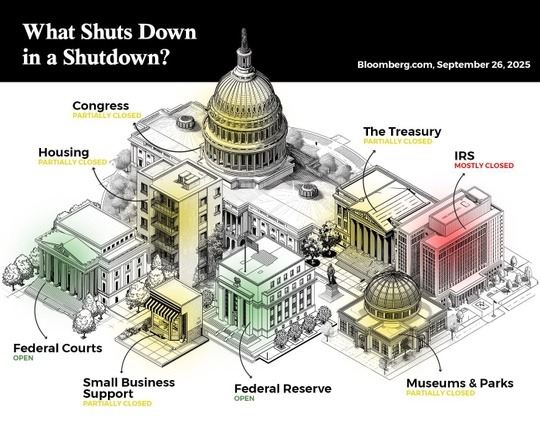
Image source FMG Suites